Inter Faith Week 13 – 20 November 2016

Inter Faith Week takes place this year between 13 – 20th November.  There are a number of exciting events taking place across the borough.

Monday 14th The trustees of Gurdwara Guru Singh Sabha Hounslow TW3 3UA welcome visitors to share the celebrations for Guru Nanak’s Birthday between 11 and 1.

Tuesday 15th  Working Lunch for faith leaders. Follow Up to the Mayor of Hounslow’s Meeting of Faiths on social action. 12 – 2, Hounslow Civic Centre TW3 4DN.

Wednesday 16th  Hounslow’s Response to Refugee Realities. A meeting to hear about present needs and the possibilities for getting involved. Speakers from Hounslow Council, the Refugee Support Network, Citizens UK, Migrants Organise and the Heathrow Immigration and Removal Centre. St John’s Church Hall, Isleworth TW7 6NY.

Saturday 19th  Women’s Felting Workshop. 9.30 – 12.30 or 1.30 – 4.30. Centre for Spirituality and Cultural Advancement, Manor Lane Feltham TW13 4JQ. Funded by Near Neighbours.

Saturday 19th Faith and Cohesive Communities. Venerable Seelawimala warmly invites guests to attend the London Buddhist Vihara for an Interfaith event at 5pm at the London Buddhist Vihara, The Avenue, Chiswick W4 1UD.

The week aims to increase awareness of the different faith communities in the UK and celebrate the contribution their members make to their neighbourhoods and to wider society.  It also is an opportunity to increase understanding between people of religious and non-religious beliefs. For further details on any of these items, see under Events or contact us.

For other events happening nationally see https://www.interfaithweek.org


Concern for Refugees

Many faith groups and others in the borough are concerned about the plight of refugees and are doing what they can to respond.  Some have made collections for refugees in Calais. Others are considering sponsoring a refugee family from Syria or may be supporting people already here.

HFOF Vice Chair Tom Gillum, vicar of St John’s and St Mary’s Church in Isleworth is organising a meeting to consider together the extent of work already being done, to see what more might be possible and what volunteer or other opportunities there are.  This will take place in the Hall at St John’s Church, St John’s Road, Isleworth TW7 6NY on Wednesday 16th November at 7.30pm. Please get the word out and let Tom know if you are interested in coming along on 07825 041432 Tom.gillum@london.anglican.org

Singing peace with a smile

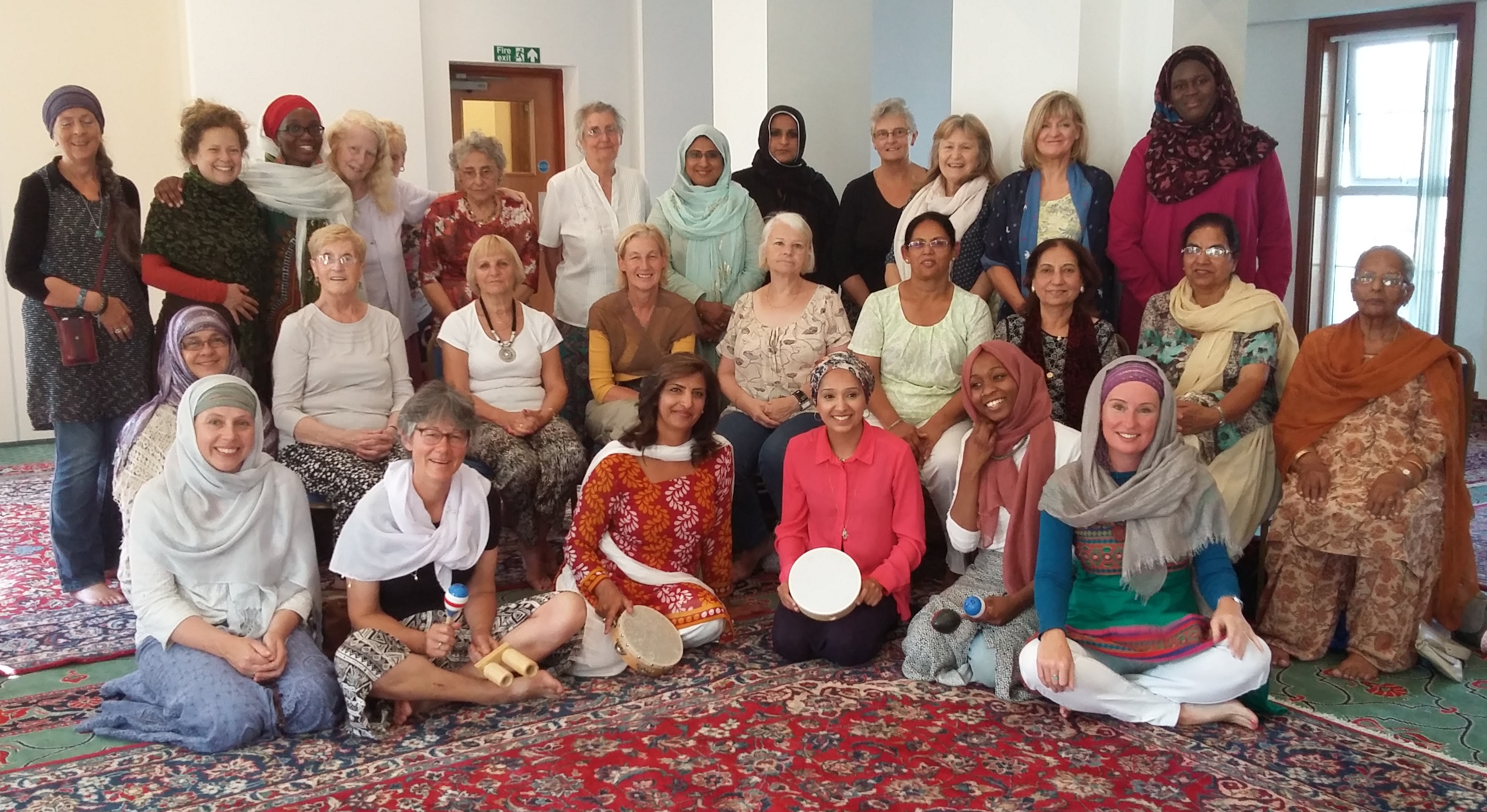
Women's Interfaith tea party 1Over 30 women shared hymns, songs and chants from their faith traditions at a gathering in Feltham on 6th August.  Interesting connections in practice were found.  Many songs offered praise to God, and gave a vision of the oneness of the divine. Singing can bring detachment from the burdens of everyday life and a focus on the truth of one’s faith. While quiet times at home are valuable, singing together in community in church or temple can touch the heart.

Words and music provide a form of spiritual practice in very many faiths either in addition to the main observance or as an essential part of it.  For example for Methodists, one of the Christian churches, singing is an essential part of worship, though the founder, John Wesley, warned members not to raise their voices louder than anyone else and for all to ‘attend to the words’.  In the latest Methodist hymn book, Singing the Faith, words in some traditional hymns were changed to be more inclusive for modern times.  The example offered from the Church of England hymnbook used wording reflecting the Jewish root of the faith.

The Sikh chant spoke of God as One.  ‘There is one spring, the name is God.  Love is God and God is love’ was the inspiration of the Hindu example. Muslim and Jewish contributions demonstrated how singing praises God. Say salaam, peace, with a smile!

Even when music does not play a part in worship, such as in a Quaker Meeting, it can inspire action, such as the Negro spiritual ‘Gonna study war no more’!

Hosted by the Centre for Spirituality and Cultural Advancement, the session ended with generous refreshments when tea and conversation flowed.  It is hoped the event can be repeated.

Hounslow Friends of Faith run a regular women’s group, meeting usually monthly.  Get in touch if you’d like to come along.

Religious and Spiritual Experiences – what can we learn from them?

Talk at AGM 20.7.16 crp - Copy (2)Human beings are naturally spiritual, so research shows, and demonstrate this in many different ways, formal and informal. Understanding the different ways this is expressed and how cooperation is necessary between faiths is essential for good community relations. Interfaith groups have their part to play in achieving this. So stated Marianne Rankin, Director of Communications for the Alister Hardy Trust in a talk organised by Hounslow Friends of Faith in Hounslow on 20th July 2016. Below is an edited version of what she said.

Marianne told the audience the definition of Religious or Spiritual Experience given by Sir Alister Hardy: A deep awareness of a benevolent non-physical power which appears to be partly or wholly beyond, and far greater than, the individual self. Spiritual experience offers a glimpse of the beyond, she said. Awareness ranges from a momentary experience of awe and wonder right across the spectrum to the intensity of mystical experience.

Although it seems many people have spiritual experiences, Marianne said, they are reluctant to speak about them, often for many years. But as soon as they are encouraged to do so, they share what they have experienced at great depth. There have been accounts of spiritual experiences throughout the ages which have been studied by academics in various disciplines – notably William James. In the UK it was Sir Alister Hardy who began the research. He was a Darwinian biologist who lived from 1896-1985. Hardy was the Linacre Professor of Zoology at Oxford, where he taught Richard Dawkins. He looked at the findings of anthropologists who have, in fact, not yet found a civilisation without some recognition of a power beyond the human being, something ‘other’ to which humans relate, and which they revere. Hardy believed that spirituality was a natural part of consciousness. His vision was of a scientific theology, a natural theology.

In 1925 Hardy first became aware of accounts of spiritual experience in the press and began a collection of accounts using a press agency. He then placed adverts in the religious press, with a poor response. So he turned to the secular newspapers, the Guardian, Observer, Times and Daily Mail. There, after a short article or example of a spiritual experience, he posed what is now known as ‘The Hardy Question’: Have you ever been aware of or influenced by a presence or power, whether you call it God or not, which is different from your everyday self?

There was an overwhelming response, as readers sent in about 3000 accounts of experiences they had never dared share with anyone before, for fear of being thought abnormal. This was the beginning of what is now an archive of about 6,000 accounts held at the Religious Experience Research Centre (RERC) at the University of Wales,Trinity Saint David in Lampeter.

Hardy considered that spiritual experience was a universal natural human trait and his successors extended the research from the UK to China despite religion being suppressed there since 1949. Studies were also conducted in Taiwan, Turkey and Tamil Nadu in India. In all cases it was found that the phenomenon of spiritual experience was widespread and among people of all types.

For many people traditional religion is a structure which suits them and underpins their lives as well as offering a community of like-minded people as companions on their religious journey. However, there are probably more for whom in the 21st century, it does not work.
A survey by David Hay, a former Director of RERC and biographer of Sir Alister Hardy showed that in 1987 48% of people reported some kind of spiritual experience. By 2000, despite church attendance having dropped by 20%, this had risen to 76%.

Although in some ways formal religion seems on the margins today, it is clear that, despite the assumption in the 20th century that religion would die out, this has not happened. Religion is still powerful and our world is now threatened by religious fanatics. To combat this, Marianne said, those who understand the true heart of faith need to have a higher profile and to stand up to misinterpretation – particularly of Islam. Organisations like Hounslow Friends of Faith, which bring traditions together and encourage co-operation between religious traditions, are even more important than ever.

If the spiritual side of human nature is real and universal, then religion and spirituality will not die out. The message of love, found in all traditions and the code of conduct expressed in the Golden Rule (Do as you would be done by) must be our aim of working together for peace in the world, she said.

Each year on, for example, Remembrance Sunday, leaders of different religions are seen together, visible evidence of working together. “We need more of this” she said. “Public representation of harmony between them is important as is co-operation in our communities.”
Marianne added that “if we allow that which is beyond to come through, it can transform ourselves and our world. These experiences seem to point the way to understanding what it means to be truly human.”

Marianne Rankin is author of An Introduction to Religious and Spiritual Experience (Bloomsbury 2008). A full version of her talk to HFOF is available from the HFOF Information Officer on the usual contacts.

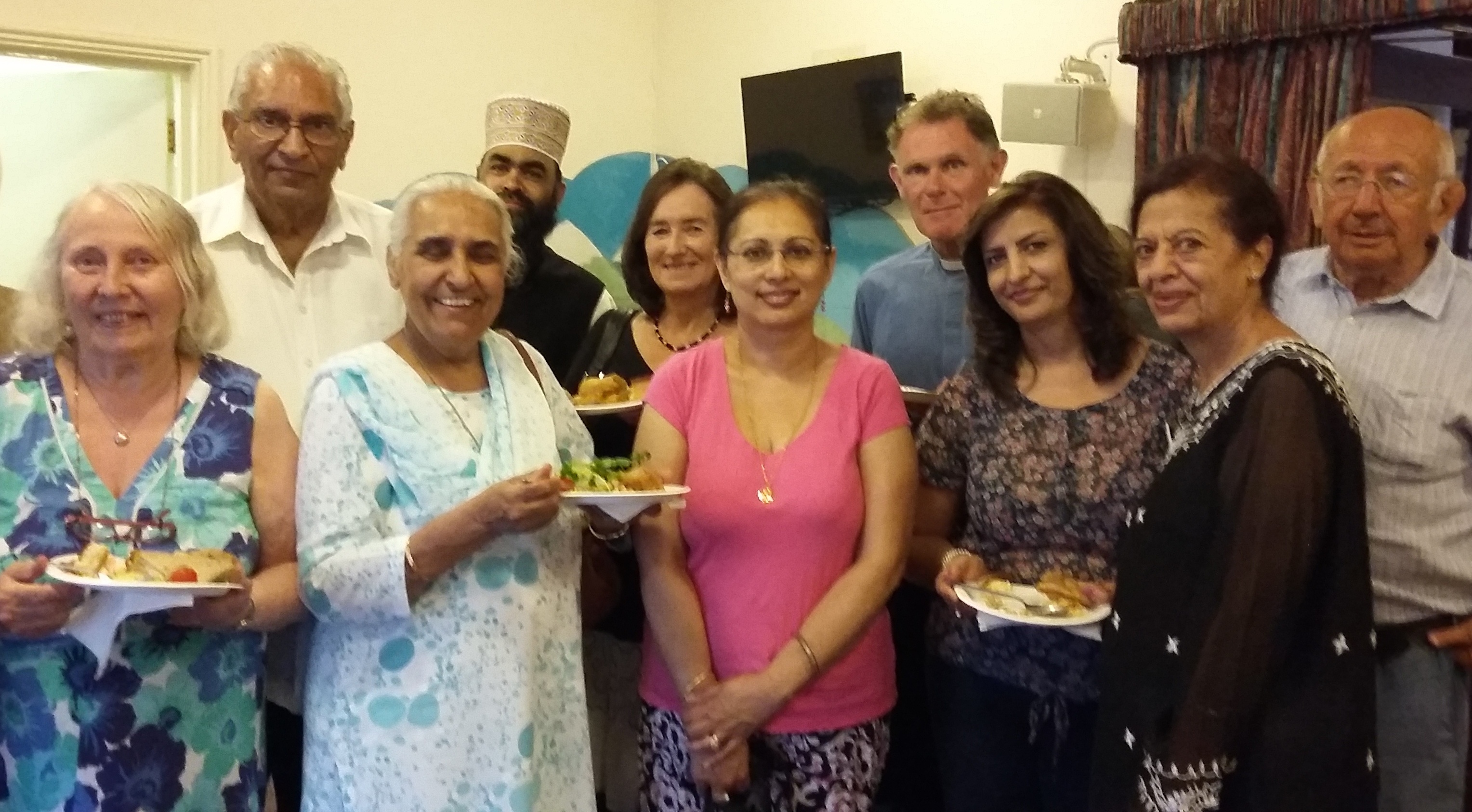
The photograph shows Marianne fifth from the left, enjoying refreshments with the audience after her talk.

Widening horizons through walking together

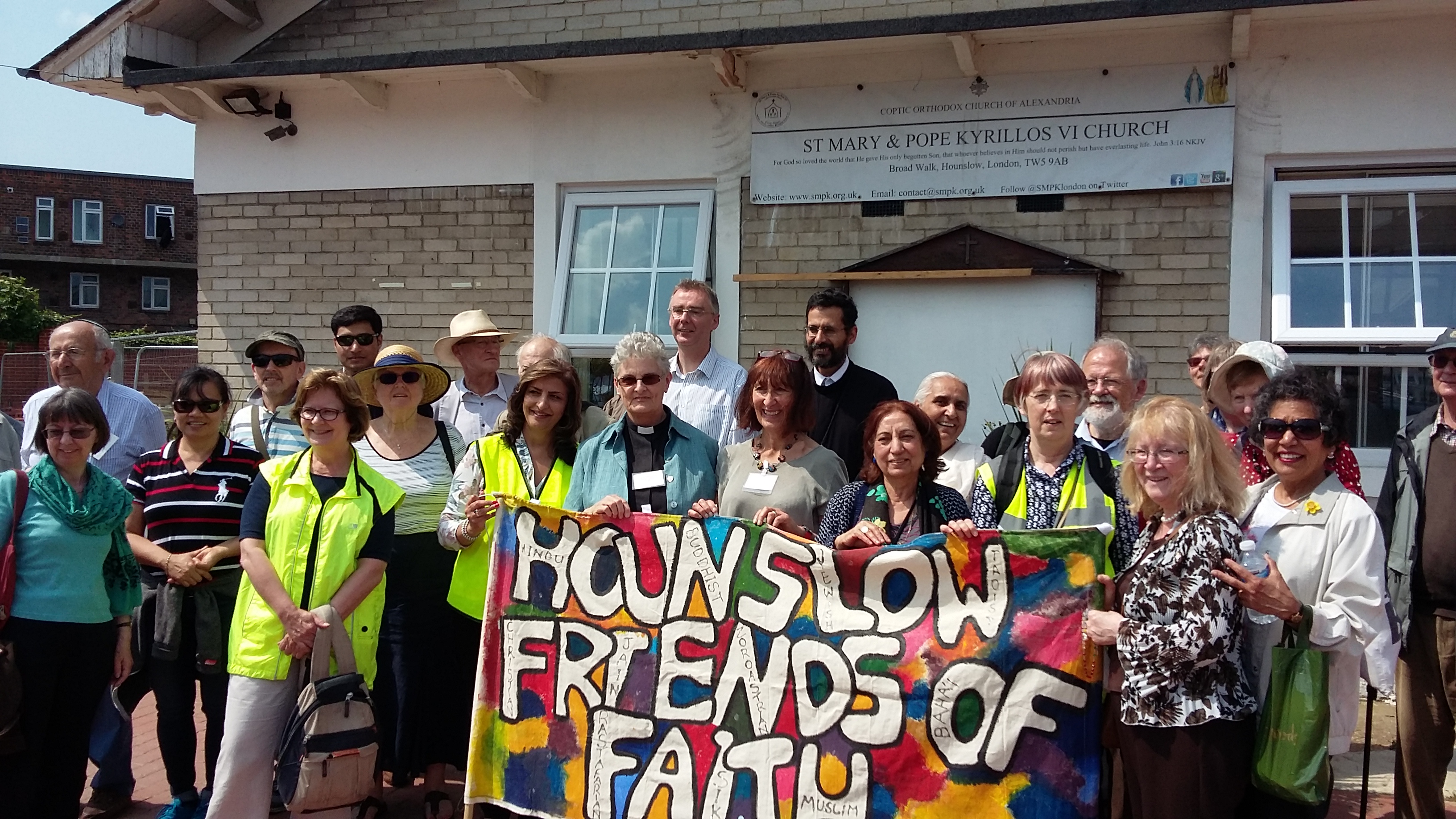
Group at Coptic Church webWell over 50 people enjoyed brilliant sunshine as they took part in HFOF’s annual Walk of Peace and Friendship on 5th June 2016.  The route comprised four places of worship in Hounslow, visiting Muslim, Christian, Hindu and Buddhist centres.  All are establishing themselves so they can live their lives well in the local community.

The event began at Heathrow Jamia Masjid in Park Lane in Cranford which has recently completed the first phase of the development of a disused British Legion Building into an attractive and well maintained centre for services for the Muslim community.  Walkers were encouraged to find time and love for humanitarian work.  The pilgrimage continued to the St Mark and Pope Kyrillos VI Coptic Orthodox Church in Broad Walk.  Father Morkos explained how icons are ‘written’ not painted, to give a sense of the life of the saints, rather than a portrait.  This church provides food for homeless people.

Moving on, the next visit was to the Jalaram Jupadi Hindu Mandir in Barrack Road where walkers were impressed by the newly extended building, now better able to provide service including meals to anyone in need in their area.  The final visit was to the Dewachan Nepalese Buddhist Centre in Munster Avenue.  The group have recently launched themselves as a centre and are looking for bigger premises to meet better the needs of their community.  Lama Dharam Gurung explained how Buddhists work for religious and racial harmony.

The Mayor of Hounslow Councillor Ajmer Grewel, her consort Councillor Pritam Grewel and Ruth Cadbury MP joined in the Walk.   The Mayor welcomed the event as a way to meet people rather than make assumptions from observation from a distance.  She praised faith groups for the service they provide to the community.  Charanjit Ajit Singh, Chair of Hounslow Friends of Faith, welcomed the new energy which newer faith groups bring.

Commenting at the end of the day one first time walker described the event as an eye opener.  ‘My horizons have been widened’ she said.


Neighbours in Faith

Neighbours in Faith 032 (2) in Council Chamber 1 cpd50 people representing a wide range of faith communities came together on 11th April 2016 and shared the joys and challenges of meeting some of the social needs in the borough at this stimulating conference at the Civic Centre.  The meeting for Faith Leaders was the initiative of the Mayor of Hounslow Councillor Nisar Malik who opened the event by thanking places of worship for the positive difference which faiths can make through social action, dialogue or shared learning. ‘Whatever our differences, our neighbourhood is what we have in common’ he said.

The aims of this conference were

1. to celebrate the social welfare work of faith communities

2. to share information on what work faith communities are currently doing

3. to look at any issues where providers need support e.g. buildings, volunteers,

funding, advice re Health and Safety, safeguarding etc.

4. to look at ways these could be addressed either informally between faiths or with the support of Hounslow Council

5. to look at social and economic indicators in the borough and assess if there are

areas of need where faith communities could help

Before moving to the first speaker Charanjit Ajit Singh, Chair for the day referred to the recent report ‘Living with difference: community, diversity and the common good,’  the report of the Commission on Religion and Belief in British Public Life chaired by Baroness Butler-Sloss and published by the Woolf Institute in December 2015.  The full report can be found at https://corablivingwithdifference.files.wordpress.com/2015/12/living-with-difference-community-diversity-and-the-common-good.pdf.

The conference heard presentations from four faith groups: Holy Trinity Hounslow about the Olive Branch project for homeless single men; St Paul’s Hounslow West and their services which make a response to lack of resources for food and a sense of family; the Sikh Gurdwara Sri Guru Singh Sabha in Alice Way, Hounslow whose Wellbeing service provides volunteers who give advice on a range of health issues including alcohol and domestic violence; and finally the range of services provided by the Darussalam Masjid and Islamic Centre in Heston for young Somalis, including involvement in rugby as sponsored by the RFU.

A survey completed before the conference showed projects run by faith communities include health information, debt advice, support for people suffering homelessness, and toddler groups.  Joan Conlon, Community Inclusion and Participation Manager for Hounslow Council stressed how helpful it is to know the full range of the good work being done.  Please let her know your project, however small on joan.conlon@hounslow.gov.uk.

It is also useful if the Directory of Places of Worship in the borough is kept up to date.  Please send any changes to info@hounslowfriendsoffaith.org.

The Hounslow Council Joint Commissioning Team explained the Life Project, the title for a grouping of a wide range of services of public and NHS health, social care and community projects aiming to support people with age or health needs to remain living at home and delay and reduce their use of hospital services. This will include advice, appropriate supported housing, falls prevention, services for people with dementia among others.

In workshops on homelessness, health matters, asylum seekers/new arrivals, families and young people and education the faith volunteers highlighted what would assist their work.  The main issues were

1. Information on how and where to refer people on to, including during unsocial hours

2. The legal framework when responding to asylum seekers

3. Training for volunteers on good practice in responding to people with often multiple and challenging needs

4. Support for users with, particularly, mental health needs and also domestic violence

5. a borough wide registry of services

Debbie Brenner, Vice Chair of Hounslow Community Network (HCN), the collective voice for voluntary groups in the borough of Hounslow, encouraged faith groups to join HCN.  The forum can provide information on e.g. funding, new initiatives, and ‘Meet the Developers’ sessions when voluntary groups could discuss benefits as the result of a new development in an area.  The group can make representations when cuts to public services are being planned.  HCN is represented on bodies such as the Safer Neighbourhood Board, and the Forums for Adult Care and Mental Health. See http://www.hounslowhub.org.uk for more information.

Uttam Gujral, Head of Community Investment and Cohesion, Community Partnerships Unit at Hounslow Council described the role of her department which is to promote partnership with community groups and Hounslow Council, community cohesion and to support forums. The aim of the Unit is to increase the ability of voluntary groups (the Third Sector) in the work they do to benefit the community.  Uttam asked for feedback from faith communities to know how this arrangement is working and where there are gaps. Email uttam.gujral@hounslow.gov.uk

Those present agreed repeating this meeting would be welcome.  Councillor Malik, Mayor of Hounslow again thanked faith groups for the work they do.  He felt the conference had been very useful to learn what is being provided and what needs there are.  Examples were a Directory of Information to assist signposting and for training.  He agreed there was a definite need to meet again.


Celebration of Chanukah, the ‘Festival of Lights’

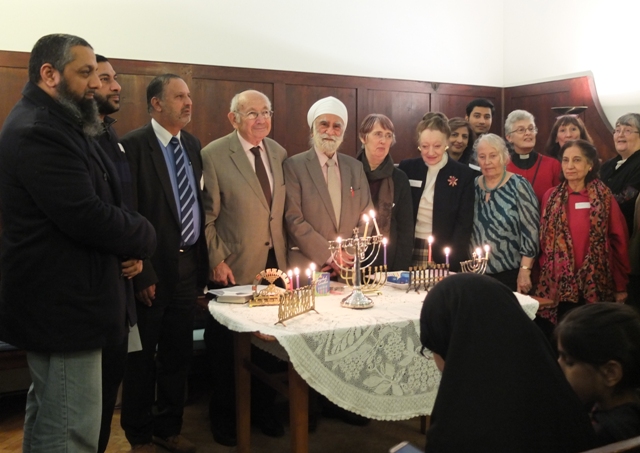
Anne 2 webThe start of Jewish Chanukah or the Festival of Lights was celebrated on 6th December at a well attended gathering in Isleworth.  Members of the local Orthodox and Liberal Jewish community explained the history and traditions of the event and lit candles on examples of the nine branched menorah, or candelabra.  Guests enjoyed music and traditional food such as potato cakes known as latkes and doughnuts.  In Jewish families token gifts are given to children, in the past silver threepences, and now chocolate coins, explained Debbie Brenner.

The festival commemorates the Jewish people’s successful fight to worship their religion freely over 2000 years ago in 162 BCE.

‘Hounslow synagogue sadly had to close in 2008 due to falling numbers which limits the opportunity for personal contacts and information sharing with the Jewish community.  We were delighted to accept the offer by Brentford and Isleworth Quakers to host the occasion’ said Basil Mann.

The event was organised by Hounslow Friends of Faith and attended by 50 people representing many faiths and beliefs.  The vote of thanks was given by Abdul Majid, trustee of the Hounslow Jamia Mosque.  ‘We are all one family and must look after each other’ he said’.

See Gallery for more pictures.

Emotional Intelligence and Happiness. Where does faith fit in?

Presentaton to Vijay Rana 16.11.15What gives meaning to our lives and brings real happiness?  The answer seems to be belonging to and offering service to something bigger than oneself.  Being part of a group, particularly one with values such as a faith group can be the solution. This argument formed the basis of a talk given in Hounslow on 16th November during Inter Faith Week by Dr Vijay Rana.

Dr Rana referred to a 2011 Gallup poll in the US which showed that people are most happy and content when they have social connection.  Quoting the work of psychologist Professor Seligman, he recommended cultivating positive emotions.  Trivial pleasures are only temporary.  True happiness will come from our attitude, monitoring our feelings and being in control, of our senses, our minds and our speech – a strong link to Buddhism here. The other inspiration referred to by Dr Rana was the Hindu Bhadavad-Gita.  This teaches how much we are driven by our senses.  It is good to remember that over our senses is our mind and above that comes our intellect.  This can help us regain control and achieve well being.

Dr Rana is editor of the magazine Health and Happiness 4 You and author of ‘Mahatma Gandhi: Images and Ideas for Non-violence’.  He worked for the BBC World Service for 25 years and still writes for the Indian English language daily, the Indian Express.

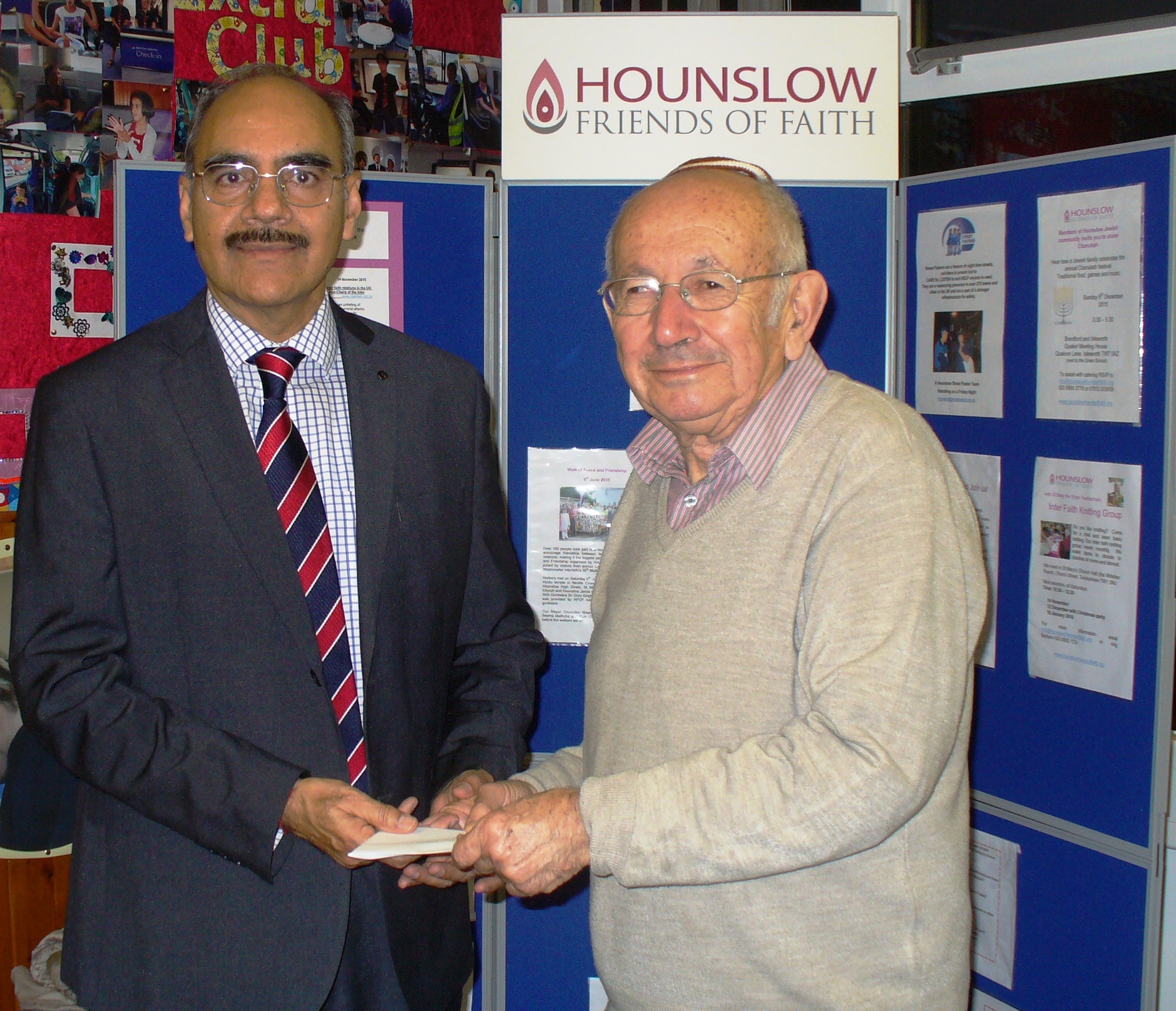
The talk was followed by a social and refreshments. The photograph shows Vijay Rana being thanked by HFOF committee member Basil Mann.

Peace and Remembrance

Corridor Queens 1Children from three primary schools in Richmond presented artwork for an exhibition on Peace and Remembrance during November.

Coordinated by Hounslow Friends of Faith and Richmond SACRE, (Standing Advisory Council for Religious Education) the children from The Queen’s, Darrell and Archdeacon Cambridge primary schools staged an exhibition using local stories of conflict, remembrance, peace-making and citizenship during the First World War.

The exhibition was based at Orleans House Gallery in Twickenham, thanks to a generous grant from Richmond’s Civic Pride fund.  It ran for from 4th to 22nd November inclusive, covering both Remembrance Day and Inter Faith Week from 15th  to 21st November.

Charanjit Ajit Singh, Chair of Hounslow Friends of Faith, a member of both Richmond and Hounslow SACRE and also Vice Chair of Richmond Inter Faith Forum, said: “the project helped the children learn about the impact of conflict on families and on refugees and how they can use this understanding to work towards peace in their school and community”.

During WW1 refugees from Belgium lived for a time in East Twickenham.

The exhibition was launched on 4th November in the Octagon Room in Orleans House Gallery, Riverside, Twickenham TW1 3DJ.  A selection of work remained in the main building until 22nd November.


Buddhism in a Multi-faith Society

Mindfulness, harmony and peace are the ideals which Buddhism can bring to society. Speaking at the HFOF AGM in July 2015 Ven. Seelawimala gave the interested audience an overview of what Buddhism can offer in multi-faith Britain.  With migration and intermarriage there is now wide religious diversity in the UK and living together with tolerance and understanding is essential.  While Buddhism does not have a sense of a deity, it shares common values and ethics with other faiths.

Ven Seelawimala gave a brief history of the life of the Buddha who lived over 2600 years ago.  Buddhism was introduced to the UK towards the end of the nineteenth century and the London Buddhist Vihara in Chiswick, where he is Head Monk was established in 1926.

To help us to live harmoniously we should work to develop right speech.  We should refrain from lies; use speech in a positive way with kind words and patience.  Even when we disagree, we must not be hurtful.  We must fill our heart with love and compassion whatever the provocation.

People should think carefully before they convert to a different religion, but if they do they must be even more tolerant of their former faith. He quoted the 3rd century BC Emperor Ashoka ‘Whosoever condemns injures his own religion.  Concord is good’.

During questions the value of mindfulness through meditation was raised.  Mediation is used now in many settings including the NHS.  Walking meditation was also mentioned where the changing process of our steps assists the process.  We were recommended to do one minute of meditation in every 59 of work.

By request the session ended with a short experience of meditation.